Burners Light, Oven Dead: Reading the 240-Volt Side
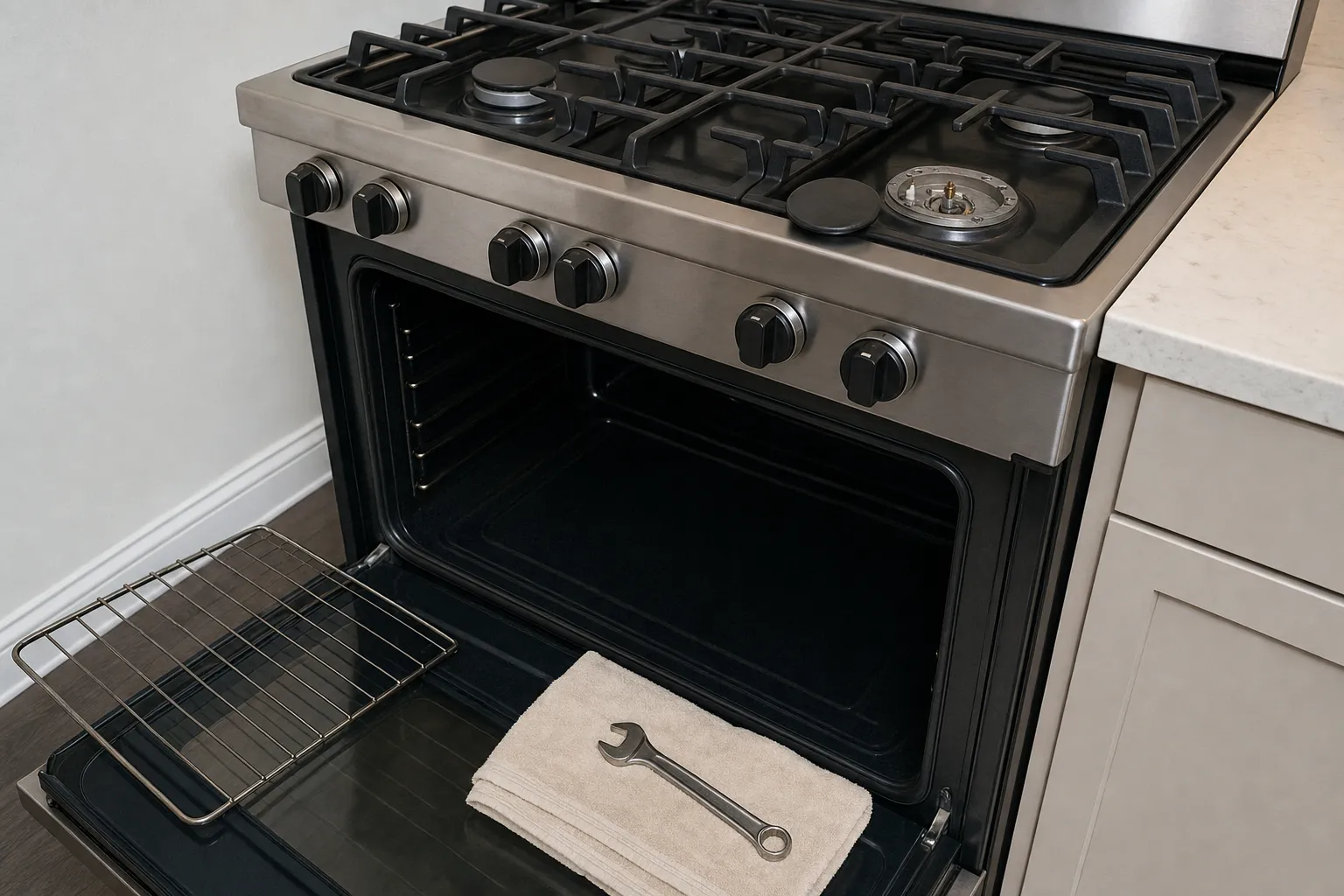
The burners catch and hold a low flame. The oven is set to bake and nothing follows: either its knob shows no temperature at all, or it shows one and the cavity is still cold twenty minutes later. On a Wolf dual fuel range that pairing places the fault on the electric side before a panel comes off, and the way it fails narrows it further.
We read the electric side from the outside in: what the oven shows, the breaker, the supply where it enters the range, and only then the oven’s own parts.
What still works tells us which half failed
The gas that reaches the burners needs no help from the house wiring. Wolf’s use and care guide for its current ranges says the surface burners can be lit by hand with a lighter during a power cut. The oven is the opposite. Its elements run on the whole 240-volt supply, both legs of it, and Wolf’s installation guide lists the same elements giving noticeably less heat on a 208-volt service.
The spark, the lights and the electronics need only a small share of that supply. On a range wired the usual North American way they can keep working from one leg while the elements, which need both, stay cold. That is why the exact symptom matters on the phone. A knob that shows a set temperature above an oven that never warms points to the heating circuit or to a missing leg. A knob that stays blank while the burners spark normally points to the control side instead: its settings, the knob, the wiring or the control itself.
Settings come before the panel
Wolf’s troubleshooting lists dead-looking ovens that are not faults, and we go through them with the owner before booking. The steps below are from the use and care guide for the current generation, the DF30450, DF36450 and the other ranges built from 2021 on. The legacy ranges built from 2002 to 2020, the DF304, DF366, DF486 and their siblings, have a guide of their own, and we check against the one that matches the rating plate.
- The knob display. Wolf’s first step for a blank oven knob is to take the knob off and refit it, then leave the range without power at its breaker for 20 seconds.
- The clock. It has to be set again after a power cut, it sets itself on a range joined to Wi-Fi, and Wolf stresses the correct time for timed cooking.
- The 12-hour limit. Outside Sabbath and dehydration, the oven turns itself off after 12 hours of continuous use, which can pass for a failure at the end of a slow cook.
- Sabbath. SAb on the oven knob means the range is in Sabbath mode.
- A second oven. On the 48-inch double-oven ranges common along the island’s west shore, the other oven cannot be used while one is in Clean.
- A dark clock. A clock that goes out after use is the standby setting, which the owner can switch off in the settings menu.
The last owner check is the breaker, off for 20 seconds and back on, which is also Wolf’s reset for a control that does not respond. Past the panel, the range is ours and the house wiring is an electrician’s.
The supply is read where it enters the range
Wolf’s installation guide gives a dual fuel range a circuit of its own: grounded, 240/208 volts at 60 Hz, rated 30 amps for the single-oven models and 50 where there are two ovens. The cable ends at a terminal block on the back of the range, connected three-wire or four-wire, so taking a reading there means drawing the range out of its opening. In the tight cabinet runs of Town Center kitchens, that is most of the labour.
At the block we read each leg to neutral and then leg to leg. A missing leg gives exactly the lit-knob, cold-oven version of this fault, and it puts the break upstream of the range: a two-pole breaker that has failed on one side, or a loose conductor in the cord or the junction box. We write the readings down and hand that part to an electrician. A supply that is present but low matters as well, since the elements simply make less heat at 208 volts, and some multi-unit buildings are fed at that voltage.
Past the supply, the oven’s own parts
With both legs proven, the fault is inside the range, and the parts that can stop an electric oven heating are few: a loose or failed connection, an element that reads open or shorted, the oven’s over-temperature protection, a relay that no longer switches, the temperature sensor, or the control.
The elements come first because there are several: bake, broil and, on the convection models, the elements behind the fans. Each is read by resistance with the power off, and an element can fail open with nothing visible on it. When every element reads correctly on its own and still none of them heats, the parts they share come next: the over-temperature protection, the relays and the wiring that feeds them.
Then the live test. With the range powered we watch each element draw current when the control calls for it. An element that reads correctly cold but draws nothing under that call sends us to the relay or the control. The temperature sensor is read against Wolf’s figure for that serial, because a sensor that has failed can make the control refuse to heat rather than run blind. The rating plate is read before anything is ordered, since the part numbers follow the model and serial.
Priced by the part inside the range
Once the fault is inside the range, it is priced as that one part: the $89 visit comes off the repair when you approve it. The temperature sensor and the oven control are the two parts here with published bands, set out on our dual fuel cost page. Elements, the over-temperature protection and a relay board have no band; each is quoted after the diagnosis, from the part number that matches the serial. Mercer Island Wolf Appliance Repair, (206) 785-2960.
Follow-up questions
Why do the burners on my Wolf dual fuel range work when the oven does not?
Because the two halves share very little. The burners run on gas and can even be lit by hand in a power cut, while every oven element needs the whole 240 or 208-volt supply across both legs. A range can lose part of that supply and still spark its burners. Mercer Island Wolf Appliance Repair measures both legs on the $89 visit.
Does the clock on a Wolf dual fuel range matter after a power cut?
Wolf's current guide asks for the clock to be set again after an outage, sets it automatically on a range joined to Wi-Fi, and stresses the correct time for timed cooking. After a storm we ask about the clock, the knob display and the breaker together, before booking anything. Mercer Island Wolf Appliance Repair, (206) 785-2960, answers the phone around the clock.
Can I test the 240-volt terminal block myself?
No. The owner's side ends at the breaker panel: twenty seconds with the range's breaker off, then power restored, is the reset Wolf itself gives. The terminal block sits on the back of the range beside live 240-volt conductors, and reaching it means drawing the range out. That reading is ours; the house wiring behind it belongs to an electrician.
Is a dead oven on a dual fuel range worth repairing?
Usually. What stops the oven heating is one component, an element, the over-temperature protection, the sensor, a relay or the control, and none of them touches the gas top. Mercer Island Wolf Appliance Repair names the failed part after the $89 diagnosis and puts one figure in writing before anything is ordered; call (206) 785-2960.
Filed as B1 in Two Fuels, One Range, read in order with the rest of series B.
Written up by
Imogen Fairhurst
12 years in the trade · Cooking-appliance technician — ovens and calibration